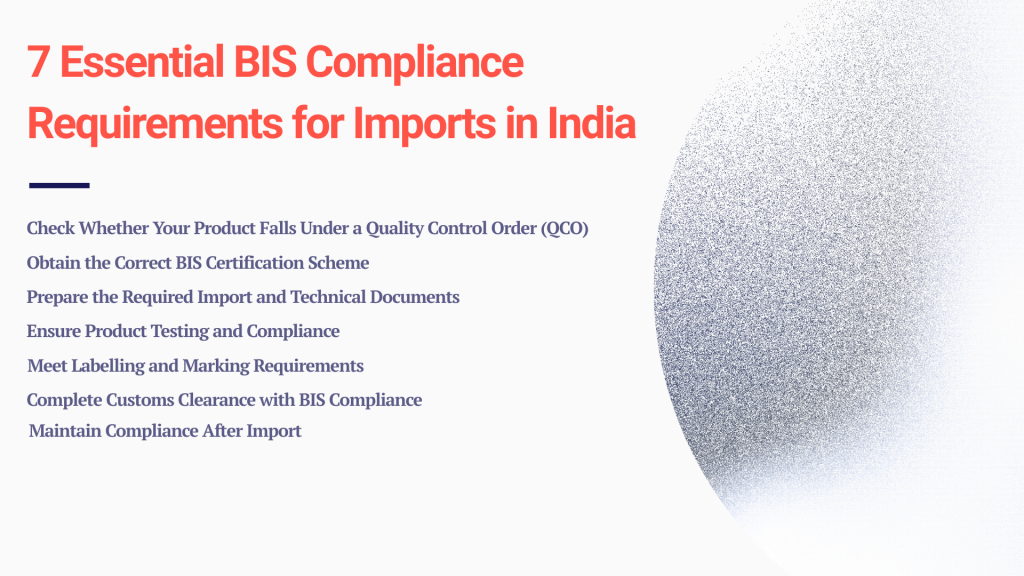
7 Essential BIS Compliance Requirements for Imports in India
Importing products into India involves more than arranging international shipping and completing customs formalities. Depending on the product, importers may also need to comply with quality standards, product certification, labelling regulations, environmental requirements and other government regulations before the goods can be legally imported, sold or distributed.
One of the most important requirements for certain regulated products is compliance with the Bureau of Indian Standards (BIS). Products covered by a mandatory Quality Control Order (QCO) may need to meet a specified Indian Standard and obtain the applicable BIS certification or registration before they can enter the Indian market.
Importers should also check whether additional environmental obligations apply to their products or packaging. In some cases, this can include EPR compliance for imports in India, particularly for products or packaging covered by India’s extended producer responsibility regulations.
Understanding the requirements before placing an order or shipping goods can help businesses avoid customs delays, additional storage costs, rejected consignments and compliance-related complications.
What is BIS Compliance for Imports in India?
The Bureau of Indian Standards (BIS) is India’s national standards body responsible for activities related to standardisation, conformity assessment, product certification and quality assurance.
BIS certification is generally voluntary. However, the Government of India can make compliance mandatory for specific products through Quality Control Orders (QCOs) and other applicable regulatory requirements.
When a product is covered by a mandatory QCO, manufacturers and importers must comply with the relevant Indian Standard and the applicable BIS conformity-assessment requirements. This means BIS compliance for imports in India can become a legal requirement rather than simply a quality certification.
Importers should not assume that a product is exempt because it is manufactured outside India. Mandatory Indian product requirements can also apply to imported products unless a specific exemption is provided.
The first step is therefore to identify the exact product, model, technical specifications and intended use and then verify whether a current QCO or other mandatory requirement applies.
It is also important to understand that BIS and EPR are separate regulatory areas. BIS generally focuses on product standards and conformity, while EPR deals with responsibilities associated with waste generated from certain products or packaging.
7 Essential BIS Compliance Requirements
1. Check Whether Your Product Falls Under a Quality Control Order (QCO)
The first and most important step is to determine whether the product you intend to import is covered by a current Quality Control Order.
A QCO can make compliance with a particular Indian Standard mandatory for a specified product. The applicability may depend on the product category, technical specifications, intended application, model, manufacturing process or other characteristics.
Before placing a purchase order, importers should verify:
- Whether the product appears under a current QCO
- The applicable Indian Standard
- The effective date of the requirement
- Any amendments to the QCO
- Applicable exemptions
- The certification or conformity-assessment scheme
- Whether the requirement applies to the specific product model
This check should happen before the goods are manufactured and shipped. Discovering a BIS requirement after cargo has already arrived in India can result in delays and additional logistics or storage expenses.
Because QCOs can be introduced or amended, importers should always verify the latest regulatory position instead of relying on an old product list or information from a previous shipment.
2. Obtain the Correct BIS Certification Scheme
Once it has been established that a product is regulated, the next step is identifying the correct BIS conformity-assessment route.
BIS operates different certification and conformity-assessment schemes depending on the product and applicable regulation. The appropriate scheme should therefore be determined from the relevant QCO, Indian Standard and BIS notification.
Depending on the product, the process may involve product certification, registration or another applicable conformity-assessment mechanism.
For foreign manufacturers, compliance can involve evaluation of the manufacturing facility, production processes, quality-control systems, testing arrangements and product conformity.
Importers should not assume that an overseas certification or international laboratory report automatically replaces a BIS requirement. International standards and certifications may support the compliance process, but the specific Indian requirement must be checked separately.
A product should be assessed based on its exact regulatory requirements rather than simply its general product category.
3. Prepare the Required Import and Technical Documents
Proper documentation is a critical part of BIS compliance for imports in India.
The exact documents required will depend on the product and certification scheme, but importers may need to coordinate documents such as:
- Commercial invoice
- Packing list
- Bill of lading or airway bill
- Importer Exporter Code (IEC)
- Product specifications
- Technical datasheets
- Product drawings, where applicable
- Test reports
- Manufacturer details
- Manufacturing facility information
- BIS licence or registration details
- Certificate of Conformity, where applicable
- Product labels and packaging details
- Purchase order or commercial agreement
Consistency between documents is particularly important.
For example, the model number, manufacturer name, product description and technical specifications should correspond across the commercial invoice, packing list, product documentation and applicable BIS records.
Even a simple discrepancy can lead to additional questions during compliance verification or customs clearance.
4. Ensure Product Testing and Compliance
Testing is an important component of BIS conformity assessment for many regulated products.
The testing requirements depend on the applicable Indian Standard and certification scheme. Certain products may require specific performance, safety, chemical, electrical or mechanical tests before certification or registration can be completed.
Importers should establish the testing requirements before production begins.
Important questions include:
- Which Indian Standard applies to the product?
- Which tests are mandatory?
- Does testing need to be conducted through a specific laboratory?
- What samples are required?
- Does the testing cover the exact model being imported?
- Is the overseas manufacturing facility included in the applicable certification?
This becomes especially important when an importer purchases several models or variants from the same overseas manufacturer.
Certification for one product does not necessarily mean that every model manufactured by the same company is automatically covered.
Early testing and documentation checks can help prevent situations where goods are manufactured according to specifications that later fail to satisfy the applicable Indian requirements.
5. Meet Labelling and Marking Requirements
Product labels and markings are another important part of compliance.
Where the applicable BIS scheme requires a Standard Mark or other prescribed marking, the product must meet the relevant marking requirements.
Depending on the product and applicable regulations, packaging or product labels may need information such as:
- Manufacturer name and address
- Product name
- Model or identification number
- Country of origin
- Technical specifications
- Rated capacity or other applicable information
- Applicable standard
- BIS marking or registration details
- Importer information
- Safety or consumer information
The exact requirements differ between products, so importers should verify the applicable standard and regulations before finalising packaging artwork.
A useful practice is to conduct a label review before mass production. Correcting packaging at the manufacturing stage is generally easier than dealing with non-compliant labels after the goods have arrived in India.
6. Complete Customs Clearance with BIS Compliance
BIS compliance and customs clearance should not be treated as completely separate processes.
When a regulated product is imported, the relevant certification, registration and supporting documents may need to be available as part of the clearance process.
A typical import compliance workflow can be approached as:
Product identification → QCO verification → Indian Standard identification → BIS scheme determination → Manufacturer compliance → Testing → Certification/registration → Labelling → Shipment → Customs clearance
Problems often occur when importers focus on freight arrangements first and investigate product regulations only after the shipment has reached India.
Before dispatch, the importer should review the complete documentation package and confirm that the product description, classification, model number, manufacturer information and regulatory documentation are consistent.
Working with an experienced customs broker or freight-forwarding partner can also help coordinate the documentation and clearance process, particularly when importing a regulated product for the first time.
7. Maintain Compliance After Import
BIS compliance does not necessarily end once the shipment has cleared customs.
Importers and manufacturers should continue monitoring the status of their certification, registration and applicable regulatory requirements.
Depending on the certification scheme, ongoing surveillance, product testing, inspection or other compliance activities may apply.
Importers should regularly review:
- BIS licence or registration validity
- Renewal requirements
- Changes to Quality Control Orders
- Amendments to Indian Standards
- Product model additions or changes
- Manufacturing-location changes
- Changes to product specifications
- Labelling requirements
- Testing records
- Certification conditions
This is particularly important for businesses importing products regularly. A certification or regulatory approval that was sufficient for an earlier shipment may require review when product specifications or Indian regulations change.
Documents Required for BIS Compliance for Imports in India
The documents required for BIS compliance vary according to the product, Indian Standard and applicable conformity-assessment scheme.
However, importers should generally be prepared to provide or coordinate relevant commercial, technical and regulatory documents.
These may include:
- Commercial invoice
- Packing list
- Bill of lading or airway bill
- Importer Exporter Code
- Product datasheet
- Technical specifications
- Product drawings
- Test reports
- Manufacturer information
- Factory or manufacturing details
- BIS licence or registration
- Certificate of Conformity, where applicable
- Product label and packaging artwork
- Purchase order
- Relevant product certification documents
The documentation should be reviewed as one complete file rather than individually.
For example, if the model number shown on the commercial invoice differs from the model number appearing in the technical documentation or certification records, the discrepancy may need to be explained before clearance.
Products That Commonly Require BIS Compliance
BIS requirements apply to a broad range of products, but not every product imported into India requires mandatory BIS certification.
Depending on current regulations and QCOs, regulated categories can include:
- Electrical and electronic products
- Certain household appliances
- Low-voltage electrical equipment
- Chemicals and petrochemical products
- Steel and iron products
- Cement and construction-related products
- Batteries and related products
- Footwear and selected leather products
- Machinery and industrial equipment
- Certain textile products
- Selected automotive and safety-related products
The list of products subject to mandatory requirements can change as the Government of India introduces, amends or updates QCOs.
For this reason, importers should verify the current BIS requirements for their specific product rather than relying on a general list.
BIS Compliance and EPR Compliance for Imports
BIS certification and EPR are different compliance requirements.
BIS primarily concerns product standards, quality, safety and conformity assessment.
EPR, or Extended Producer Responsibility, focuses on responsibilities associated with managing waste generated by products or packaging covered by applicable environmental regulations.
For example, businesses importing products with regulated plastic packaging may have obligations under India’s plastic-waste EPR framework.
Depending on the product, importers may also need to consider EPR requirements associated with batteries, electrical and electronic equipment or other regulated waste categories.
Therefore, a business may need both BIS compliance for imports in India and EPR compliance for imports in India, along with customs, labelling and other product-specific requirements.
These obligations should be assessed separately because completing one does not automatically satisfy the other.
Common Challenges Importers Face with BIS Compliance
Identifying the Correct Indian Standard
One of the first challenges is determining exactly which Indian Standard applies to a product.
A product may have multiple technical characteristics, variants or intended uses, making it important to assess the specific product rather than relying only on its commercial name.
Keeping Up With QCO Changes
Government notifications and QCO requirements can change over time.
Importers that rely on outdated compliance information may discover new requirements after an order has already been placed.
Coordinating With Overseas Manufacturers
The foreign manufacturer plays an important role in the certification process.
Manufacturers may need to provide technical documents, testing information, production details and access to facilities for applicable assessments.
Avoiding Documentation Mismatches
Differences in product names, model numbers, specifications or manufacturer details across documents can create unnecessary questions during the import process.
Managing Testing and Certification Timelines
Testing, documentation and certification can take time. Waiting until the shipment is ready to leave the supplier’s facility can leave very little room to resolve problems.
Overlooking Other Regulatory Requirements
BIS may not be the only requirement applicable to an imported product.
Depending on the product and packaging, importers may also need to consider customs requirements, DGFT regulations, EPR obligations, labelling rules, environmental regulations and other product-specific approvals.
How to Avoid Delays in BIS Compliance and Customs Clearance
The most effective way to reduce compliance-related delays is to complete the regulatory review before the goods are shipped.
Start by identifying the exact product, model number, technical specifications and intended use.
Next, check the latest QCO and determine whether the product falls under mandatory BIS requirements.
After establishing applicability, identify the relevant Indian Standard and BIS conformity-assessment scheme.
The overseas manufacturer should then be evaluated to ensure it can support the required documentation, testing and certification process.
Product labels and packaging should also be reviewed before mass production.
Before shipment, conduct a final documentation check covering:
- Product description
- Model number
- Manufacturer information
- Technical specifications
- BIS certification or registration
- Test reports
- Invoice
- Packing list
- Shipping documents
- Applicable labelling requirements
- Other regulatory approvals
Importers should also check whether the product or packaging triggers EPR compliance for imports in India.
For businesses handling regular imports, maintaining a compliance checklist for each product can make repeat shipments significantly easier to manage.
Where the product is technically complex or subject to several regulations, working with experienced customs and trade-compliance professionals can help identify potential issues before they become shipment delays.
Conclusion
BIS compliance is an important consideration for businesses importing regulated products into India. The process involves more than obtaining a certificate; importers need to understand the applicable QCO, identify the correct Indian Standard and certification scheme, coordinate testing and documentation, comply with labelling requirements and ensure that the regulatory records remain valid.
The best time to address these requirements is before the shipment leaves the supplier’s country.
Importers should also remember that BIS is only one part of India’s import-compliance framework. Depending on the product and packaging, EPR compliance for imports in India and other regulatory obligations may also apply.
By checking requirements early, maintaining accurate documentation and coordinating with the overseas manufacturer, customs professionals and relevant regulatory authorities, businesses can reduce the risk of avoidable delays and make their import process more predictable.
For companies importing regulated products into India, IGF Express can support the broader logistics and customs-clearance process while helping businesses navigate the documentation and compliance considerations associated with international shipments.