7 Essential BIS Compliance Requirements for Imports in India
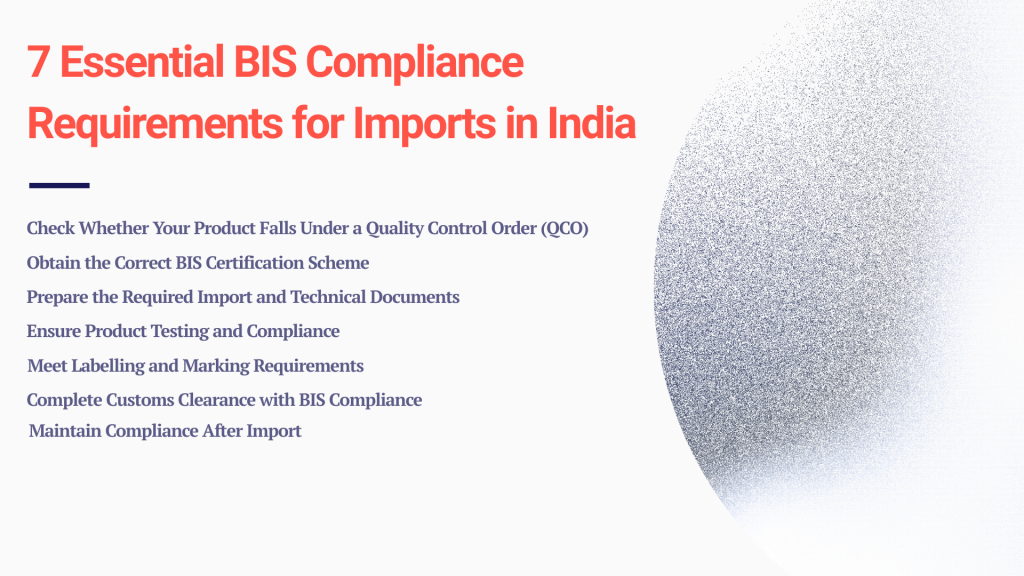
7 Essential BIS Compliance Requirements for Imports in India Importing products into India involves more than arranging international shipping and completing customs formalities. Depending on the product, importers may also need to comply with quality standards, product certification, labelling regulations, environmental requirements and other government regulations before the goods can be legally imported, sold or distributed. One of the most important requirements for certain regulated products is compliance with the Bureau of Indian Standards (BIS). Products covered by a mandatory Quality Control Order (QCO) may need to meet a specified Indian Standard and obtain the applicable BIS certification or registration before they can enter the Indian market. Importers should also check whether additional environmental obligations apply to their products or packaging. In some cases, this can include EPR compliance for imports in India, particularly for products or packaging covered by India’s extended producer responsibility regulations. Understanding the requirements before placing an order or shipping goods can help businesses avoid customs delays, additional storage costs, rejected consignments and compliance-related complications. What is BIS Compliance for Imports in India? The Bureau of Indian Standards (BIS) is India’s national standards body responsible for activities related to standardisation, conformity assessment, product certification and quality assurance. BIS certification is generally voluntary. However, the Government of India can make compliance mandatory for specific products through Quality Control Orders (QCOs) and other applicable regulatory requirements. When a product is covered by a mandatory QCO, manufacturers and importers must comply with the relevant Indian Standard and the applicable BIS conformity-assessment requirements. This means BIS compliance for imports in India can become a legal requirement rather than simply a quality certification. Importers should not assume that a product is exempt because it is manufactured outside India. Mandatory Indian product requirements can also apply to imported products unless a specific exemption is provided. The first step is therefore to identify the exact product, model, technical specifications and intended use and then verify whether a current QCO or other mandatory requirement applies. It is also important to understand that BIS and EPR are separate regulatory areas. BIS generally focuses on product standards and conformity, while EPR deals with responsibilities associated with waste generated from certain products or packaging. 7 Essential BIS Compliance Requirements 1. Check Whether Your Product Falls Under a Quality Control Order (QCO) The first and most important step is to determine whether the product you intend to import is covered by a current Quality Control Order. A QCO can make compliance with a particular Indian Standard mandatory for a specified product. The applicability may depend on the product category, technical specifications, intended application, model, manufacturing process or other characteristics. Before placing a purchase order, importers should verify: Whether the product appears under a current QCO The applicable Indian Standard The effective date of the requirement Any amendments to the QCO Applicable exemptions The certification or conformity-assessment scheme Whether the requirement applies to the specific product model This check should happen before the goods are manufactured and shipped. Discovering a BIS requirement after cargo has already arrived in India can result in delays and additional logistics or storage expenses. Because QCOs can be introduced or amended, importers should always verify the latest regulatory position instead of relying on an old product list or information from a previous shipment. 2. Obtain the Correct BIS Certification Scheme Once it has been established that a product is regulated, the next step is identifying the correct BIS conformity-assessment route. BIS operates different certification and conformity-assessment schemes depending on the product and applicable regulation. The appropriate scheme should therefore be determined from the relevant QCO, Indian Standard and BIS notification. Depending on the product, the process may involve product certification, registration or another applicable conformity-assessment mechanism. For foreign manufacturers, compliance can involve evaluation of the manufacturing facility, production processes, quality-control systems, testing arrangements and product conformity. Importers should not assume that an overseas certification or international laboratory report automatically replaces a BIS requirement. International standards and certifications may support the compliance process, but the specific Indian requirement must be checked separately. A product should be assessed based on its exact regulatory requirements rather than simply its general product category. 3. Prepare the Required Import and Technical Documents Proper documentation is a critical part of BIS compliance for imports in India. The exact documents required will depend on the product and certification scheme, but importers may need to coordinate documents such as: Commercial invoice Packing list Bill of lading or airway bill Importer Exporter Code (IEC) Product specifications Technical datasheets Product drawings, where applicable Test reports Manufacturer details Manufacturing facility information BIS licence or registration details Certificate of Conformity, where applicable Product labels and packaging details Purchase order or commercial agreement Consistency between documents is particularly important. For example, the model number, manufacturer name, product description and technical specifications should correspond across the commercial invoice, packing list, product documentation and applicable BIS records. Even a simple discrepancy can lead to additional questions during compliance verification or customs clearance. 4. Ensure Product Testing and Compliance Testing is an important component of BIS conformity assessment for many regulated products. The testing requirements depend on the applicable Indian Standard and certification scheme. Certain products may require specific performance, safety, chemical, electrical or mechanical tests before certification or registration can be completed. Importers should establish the testing requirements before production begins. Important questions include: Which Indian Standard applies to the product? Which tests are mandatory? Does testing need to be conducted through a specific laboratory? What samples are required? Does the testing cover the exact model being imported? Is the overseas manufacturing facility included in the applicable certification? This becomes especially important when an importer purchases several models or variants from the same overseas manufacturer. Certification for one product does not necessarily mean that every model manufactured by the same company is automatically covered. Early testing and documentation checks can help prevent situations where goods are manufactured according to specifications that later fail to satisfy the applicable Indian
Why is a BIS Certificate Required for Import in India?

Why is a BIS Certificate Required for Import in India? If you are a manufacturer who imports goods from another country, you need to follow an authentication rule that is called a BIS Certificate. Let’s say, if you are importing gold from Middle Eastern countries, you must undergo a verification process. Once you have a certificate, you can sell it to consumers or other companies. It’s a badge that ensures to the consumer that the product has passed quality checks. If you’re still confused about what a BIS Certificate is and why a BIS certificate is required for import in India, then this article will guide you about BIS compliance for imports in India, and also, we will know the process and products that need BIS Certification for import. What is BIS and why is it important? BIS is the Bureau of Indian Standards. It is the National Standards Body of India established by the Bureau of Indian Standards Act, 2016. It operates under the Ministry of Consumer Affairs. It is primarily responsible for ensuring that the products offered in the Indian market are of a pre-defined quality and safety level.Consider BIS as the quality checker of India. No certificate, no entry (at least for regulated products). In the case of imports, BIS compliance for imports India guarantees that items imported from outside the country are as standard as items manufactured in India. This is fair play and will ensure that Indian consumers are not deceived by buying substandard or unsafe products. Does BIS Certification Apply To All Imports? No, not all products require BIS certification. The list of regulated products is growing rapidly, however. The government of India has issued Quality Control Orders (QCOs) stating that certain categories must be certified by BIS. The products that are currently mandatory BIS-certified include electronics, steel, cement, household appliances, toys, and many more. If your product is on that list, it will not be released from customs if it is not properly certified. Mostly, the BIS certification is applied to raw materials. Therefore, before you send anything to India, please inquire whether your product is covered under a QCO notification or not. Why is a BIS Certificate Required for Import in India? The key reasons for the majority of the imports of raw materials to India to be subject to BIS certification are as follows: Consumer safety and product quality BIS is responsible for verifying that materials that are imported to India are of a certain quality, performance, and safety. BIS compliance for imports India is a filter. This is important because – Low-quality products can affect the quality of the final product in terms of its safety and durability. – Materials that present health or environmental hazards are unsafe (e.g., chemicals, metals, electronics). Facilities for the support of domestic industry standards India would want to harmonize imported raw materials with the national standards of India so that:– They can be used by local manufacturers with little modification and testing.– Production processes in different industries are consistent. The policy of self-reliance (Atmanirbhar Bharat) introduces The Government of India implements BIS certification as a part of its initiative of Atmanirbhar Bharat and quality assurance to ensure that: – Ensure that imports do not compete with the Indian producer in the market by selling inferior or low-quality products.– To safeguard the domestic industry against dumping or imports from low-cost countries that are not subject to safety standards. The prevention of the dumping of inferior goods This requirement for BIS compliance for imports India helps prevent dumping – a trade practice in which countries supply low-quality or outdated products to developing countries at reduced prices. India is taking measures to address this. There is one more reason we think a BIS certificate is important: if it is not there, people will smuggle that product. Many times you have heard of gold smuggling, cement smuggling, so it’s a term when people import products in a hidden way so that they can avoid taxes and sell them more profitably. So, to prevent the smuggling of goods, it’s also important. How to Get BIS Certification for Imports It varies in the case of foreign manufacturers and Indian importers. Here is a general outline, however: Step 1: Identify the Applicable Scheme. To begin with, you need to determine which BIS scheme suits your product—either the FMCS or the CRS, or any other scheme, such as the Certificate of Conformity (CoC) for some product categories. Step 2: Product Testing Send your product for testing at a BIS recognized or BIS approved laboratory. A report of the test is an essential document for any BIS application. Step 3: Submit an application to BIS. Apply online via the BIS Portal. You’ll be required to submit paperwork such as the test report, manufacturing information, product specifications, and more. Step 4: Factory Audit (if applicable) If FMCS, BIS will come to inspect your manufacturing plant. They examine your production processes and quality controls to ensure they comply with BIS standards. Step 5: Certificate Issuance If all is well, BIS will grant the license or registration. This enables you to affix the ISI mark or use the BIS registration number on products. Step 6: Ongoing Compliance BIS certification isn’t a one-time thing. Regular audits and product testing will be required to maintain compliance, and you are required to do this as per your scheme requirements. But IGF Express completes this process for you. As a company, you know this process is very lengthy, and you don’t know whether you will get the certificate or not. So working with professionals like IGF Express can help you reduce your stress. Why Work with a Professional for BIS Compliance? The BIS certification process is a complex one that involves a lot of paperwork, coordination with the labs, follow-ups with BIS offices, and sometimes overseas factory audits. It can become complex, particularly when the foreign manufacturers are not aware of the Indian regulations. This is where a trusted