7 Essential BIS Compliance Requirements for Imports in India
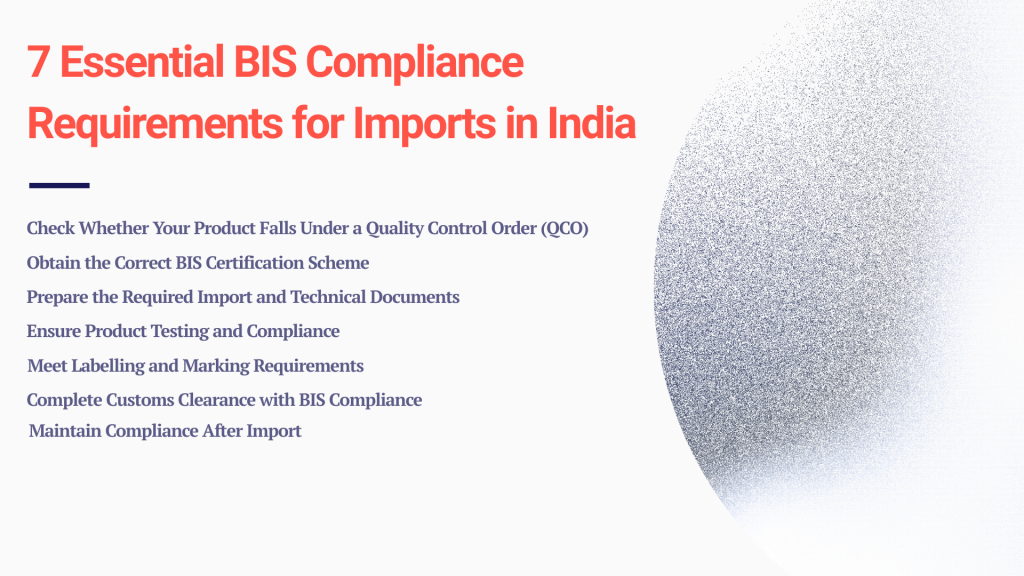
7 Essential BIS Compliance Requirements for Imports in India Importing products into India involves more than arranging international shipping and completing customs formalities. Depending on the product, importers may also need to comply with quality standards, product certification, labelling regulations, environmental requirements and other government regulations before the goods can be legally imported, sold or distributed. One of the most important requirements for certain regulated products is compliance with the Bureau of Indian Standards (BIS). Products covered by a mandatory Quality Control Order (QCO) may need to meet a specified Indian Standard and obtain the applicable BIS certification or registration before they can enter the Indian market. Importers should also check whether additional environmental obligations apply to their products or packaging. In some cases, this can include EPR compliance for imports in India, particularly for products or packaging covered by India’s extended producer responsibility regulations. Understanding the requirements before placing an order or shipping goods can help businesses avoid customs delays, additional storage costs, rejected consignments and compliance-related complications. What is BIS Compliance for Imports in India? The Bureau of Indian Standards (BIS) is India’s national standards body responsible for activities related to standardisation, conformity assessment, product certification and quality assurance. BIS certification is generally voluntary. However, the Government of India can make compliance mandatory for specific products through Quality Control Orders (QCOs) and other applicable regulatory requirements. When a product is covered by a mandatory QCO, manufacturers and importers must comply with the relevant Indian Standard and the applicable BIS conformity-assessment requirements. This means BIS compliance for imports in India can become a legal requirement rather than simply a quality certification. Importers should not assume that a product is exempt because it is manufactured outside India. Mandatory Indian product requirements can also apply to imported products unless a specific exemption is provided. The first step is therefore to identify the exact product, model, technical specifications and intended use and then verify whether a current QCO or other mandatory requirement applies. It is also important to understand that BIS and EPR are separate regulatory areas. BIS generally focuses on product standards and conformity, while EPR deals with responsibilities associated with waste generated from certain products or packaging. 7 Essential BIS Compliance Requirements 1. Check Whether Your Product Falls Under a Quality Control Order (QCO) The first and most important step is to determine whether the product you intend to import is covered by a current Quality Control Order. A QCO can make compliance with a particular Indian Standard mandatory for a specified product. The applicability may depend on the product category, technical specifications, intended application, model, manufacturing process or other characteristics. Before placing a purchase order, importers should verify: Whether the product appears under a current QCO The applicable Indian Standard The effective date of the requirement Any amendments to the QCO Applicable exemptions The certification or conformity-assessment scheme Whether the requirement applies to the specific product model This check should happen before the goods are manufactured and shipped. Discovering a BIS requirement after cargo has already arrived in India can result in delays and additional logistics or storage expenses. Because QCOs can be introduced or amended, importers should always verify the latest regulatory position instead of relying on an old product list or information from a previous shipment. 2. Obtain the Correct BIS Certification Scheme Once it has been established that a product is regulated, the next step is identifying the correct BIS conformity-assessment route. BIS operates different certification and conformity-assessment schemes depending on the product and applicable regulation. The appropriate scheme should therefore be determined from the relevant QCO, Indian Standard and BIS notification. Depending on the product, the process may involve product certification, registration or another applicable conformity-assessment mechanism. For foreign manufacturers, compliance can involve evaluation of the manufacturing facility, production processes, quality-control systems, testing arrangements and product conformity. Importers should not assume that an overseas certification or international laboratory report automatically replaces a BIS requirement. International standards and certifications may support the compliance process, but the specific Indian requirement must be checked separately. A product should be assessed based on its exact regulatory requirements rather than simply its general product category. 3. Prepare the Required Import and Technical Documents Proper documentation is a critical part of BIS compliance for imports in India. The exact documents required will depend on the product and certification scheme, but importers may need to coordinate documents such as: Commercial invoice Packing list Bill of lading or airway bill Importer Exporter Code (IEC) Product specifications Technical datasheets Product drawings, where applicable Test reports Manufacturer details Manufacturing facility information BIS licence or registration details Certificate of Conformity, where applicable Product labels and packaging details Purchase order or commercial agreement Consistency between documents is particularly important. For example, the model number, manufacturer name, product description and technical specifications should correspond across the commercial invoice, packing list, product documentation and applicable BIS records. Even a simple discrepancy can lead to additional questions during compliance verification or customs clearance. 4. Ensure Product Testing and Compliance Testing is an important component of BIS conformity assessment for many regulated products. The testing requirements depend on the applicable Indian Standard and certification scheme. Certain products may require specific performance, safety, chemical, electrical or mechanical tests before certification or registration can be completed. Importers should establish the testing requirements before production begins. Important questions include: Which Indian Standard applies to the product? Which tests are mandatory? Does testing need to be conducted through a specific laboratory? What samples are required? Does the testing cover the exact model being imported? Is the overseas manufacturing facility included in the applicable certification? This becomes especially important when an importer purchases several models or variants from the same overseas manufacturer. Certification for one product does not necessarily mean that every model manufactured by the same company is automatically covered. Early testing and documentation checks can help prevent situations where goods are manufactured according to specifications that later fail to satisfy the applicable Indian