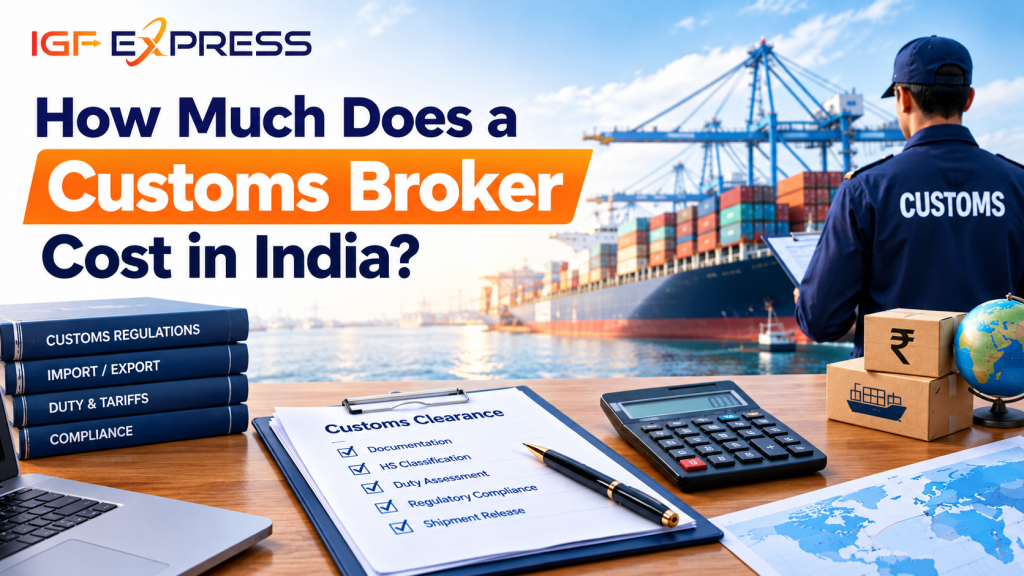
How Much Does a Customs Broker Cost in India?
How Much Does a Customs Broker Cost in India? Complete Fee Guide Choosing a customs broker is an important decision for any business involved in international trade. From documentation and customs declarations to duty assessment and regulatory compliance, the quality of customs support can influence how smoothly imported goods move through the clearance process. For importers, the challenge is not simply finding a service provider who can file documents. It is finding a professional who understands the nature of the cargo, identifies compliance requirements early, communicates clearly and helps prevent avoidable delays. This guide explains what a customs broker does, how to evaluate service providers and what businesses should consider before choosing a customs clearance partner in India. What Does a Customs Broker Do? A customs broker acts as an intermediary between importers or exporters and customs authorities. Their role involves facilitating customs procedures, preparing and submitting relevant declarations, coordinating documentation and supporting compliance with applicable customs regulations. Depending on the shipment and agreed scope of work, services may include: Bill of Entry and Shipping Bill documentation and filing. Customs duty assessment coordination. HS code classification support. Customs valuation and transaction-related documentation. Coordination for examination, queries and assessment. Support with applicable product-specific permissions and regulatory requirements. Coordination with freight forwarders, transporters, warehouses and other stakeholders. Assistance with shipment release and delivery planning. The scope of service can vary depending on the cargo, port, regulatory requirements and individual business needs. Importers should confirm exactly what is included before engaging a broker. Why Choosing the Right Customs Broker Matters Customs clearance involves more than submitting a declaration. Information provided in the Bill of Entry must align with commercial documents, product details, valuation information and applicable regulatory requirements. An error or inconsistency may lead to customs queries, additional documentation requests, examination or delays in cargo release. In some cases, incorrect classification or incomplete compliance can also create financial and regulatory risks. An experienced customs broker in India can help businesses identify potential issues before filing, coordinate the necessary documents and manage communication throughout the clearance process. For companies handling frequent imports, machinery, electronics, chemicals or other regulated goods, this support can be particularly important. Requirements should be assessed shipment by shipment rather than assuming every consignment follows the same process. Key Factors to Consider When Selecting a Customs Broker in India 1. Verify the Customs Broker’s Licence Before appointing a service provider, verify that the customs broker holds the appropriate licence and is authorised to undertake the proposed work under applicable regulations. Businesses searching for a licensed customs broker India should check the provider’s credentials, relevant authorisation and operational experience. Licensing is a fundamental starting point, but it should be considered alongside service quality, compliance practices and the ability to handle the specific type of cargo. A business should also establish which entity will actually handle its customs declarations and who will be responsible for coordination if a shipment encounters an issue. 2. Evaluate Experience with Your Cargo and Industry Not all imports have the same requirements. General merchandise, industrial machinery, automotive components, electronic equipment and chemical products may involve different classification, valuation and regulatory considerations. Ask whether the broker has handled similar shipments and understands the documentation commonly required for your product category. For example, machinery imports may require detailed product specifications, invoice analysis and careful classification. Certain electronics or industrial products may require checks for applicable BIS requirements or Quality Control Orders. Chemical and hazardous shipments may involve additional transport and handling considerations. Industry-specific experience can help identify potential issues earlier, although final requirements depend on the product, its classification and the regulations in force. 3. Look Beyond the Quoted Fee Price matters, but the lowest quotation does not always represent the lowest overall cost. A customs broker’s quotation may cover only professional clearance fees, while other expenses such as terminal charges, examination-related costs, transport, storage or additional documentation support may be billed separately. Before confirming a quotation, ask for a clear breakdown of: Professional customs clearance fees. Documentation and filing charges. Examination or special handling costs, where applicable. Transportation and delivery charges, if included. Additional fees for queries, amendments or other work outside the agreed scope. A transparent quotation helps procurement and finance teams compare providers fairly and budget for the complete shipment rather than just one service component. 4. Assess Documentation and Compliance Practices Reliable customs clearance begins before a shipment arrives. Importers should expect their broker to review the available documents and flag apparent inconsistencies or missing information. Depending on the shipment, documents may include the commercial invoice, packing list, bill of lading or airway bill, certificate of origin, product specifications, licences and other supporting records. Pay particular attention to the following areas: HS code classification: The classification should reflect the product’s actual characteristics and applicable tariff rules. Customs valuation: The declared value must be supported by relevant transaction and cost information under applicable valuation rules. Import policy: Check whether the product is freely importable, restricted or subject to specific conditions. Product compliance: Identify any applicable certification, registration or regulatory requirements before shipment. Document consistency: Product descriptions, quantities, values and other particulars should align across relevant records. A broker should not simply accept incomplete information without raising questions. Importers also remain responsible for providing accurate information and supporting documents. 5. Check Communication and Query Management A customs query can create uncertainty when no one knows what information is required, who must provide it or how it affects the shipment timeline. Before appointing a broker, understand how updates will be shared, who will be your point of contact and how assessment queries or documentation issues will be escalated. For regular importers, a defined communication process can be as important as the filing process itself. Clear updates help teams coordinate inventory planning, warehouse capacity, production schedules and onward transportation. 6. Consider End-to-End Logistics Coordination Customs clearance is one part of the import journey. Freight movement, port handling, documentation, customs release and final delivery must work together. Businesses that coordinate
The Role of India’s Most Trusted Customs Broker

The Role of India’s Most Trusted Customs Broker The import/export of goods in India is not an easy task. They have to fill in forms, abide by rules, work out duties, and deal with port officials. You will be stuck with your shipment if you skip one step. When that occurs, your business suffers. This is what makes the role of a customs broker so important, as most people think. That’s why collaborating with India’s trusted customs broker helps keep your supply chain running smoothly. What a Customs Broker Actually Does In India, a customs broker, also known as a CHA (Customs House Agent), handles the clearance of goods through customs. They prepare the documents, allocate responsibilities, and liaise with port and airport officials. It’s easy to see on paper. It isn’t, in reality. The customs regulations in India are specified. They change often. How many days or weeks can a shipment be delayed due to a simple error, such as a wrong product code, a missing certificate, or an incorrect valuation? Such a delay is detrimental to production schedules, customer relations, and profits. Businesses aren’t only looking for the person who knows paperwork when they talk about finding India’s most trusted customs broker. They need someone who understands the rules well, who can communicate effectively, and who is action-oriented and no-frills. Why Customs Clearance Is a Business Issue, Not Just a Logistics One Many companies look at customs clearance as a “background task.” They toss it off and pray that it’s going to work. However, the situation where a shipment gets stuck in customs is no simple logistical issue. It refers to a slowdown in production. It refers to unfulfilled promises to customers. It can sometimes be fines. As is often the case, a bad customs broker isn’t just an inconvenience; it’s a serious risk, especially for companies with strict schedules. This is something that India’s most trusted customs broker understands. They view each clearance as a piece of work that has business value, rather than a file to be processed. It’s in their attitude and, therefore, in how they work. Key Roles a Customs Broker Plays – Document preparation and filing The key to customs clearance is to get the paperwork right. A great broker is aware of the paperwork required for each shipment, whether it is a commercial invoice, bill of lading, packing list, or a particular certificate.They are the source of mistakes that result in delays. All is checked by a trusted customs broker before filing. – Duty calculation and classification Each product has its own classification, and the duty varies in accordance with the classification. When brokers cut corners, misclassification is often a problem. A good broker will make sure your wares are properly categorized; you’ll be charged what’s due, not more and not less. – Coordination with customs authorities Customs officers may make enquiries or request an inspection. An effective broker is familiar with what to do and how soon when asked. They work with port and airport officials in those port/airport cities where they are active. That familiarity hastens things. – Complying with changing rules Indian laws on customs are revised frequently. This is because what works well now might not work out in the years to come. India’s most trusted customs broker is always on the pulse and adapts their processes to the changes. They don’t have to wait until something goes wrong for them to learn something new. – End-to-End Coordination A good customs broker doesn’t just file your paperwork and vanish! They remain engaged—from loading through your facility. This includes the responsibilities of warehouse coordination, duty payments, and final delivery. This type of end-to-end service is important because it cuts down on the number of people you have to work with. Single point of contact. One team is responsible for the entire process. Air vs. Sea freight clearance There are different types of clearances. In some instances, the documentation needs, timeframes, and rules vary between air freight and sea freight. Many brokers are more adept at one thing than at the other. A truly capable and India’s most trusted customs broker is capable of confidently operating in both. They are available at major ports and airports, so it doesn’t matter where your shipment arrives; they can get it there. What to Look for in a Trusted Customs Broker When you select a customs broker in India, you should consider a number of factors. Experience with your product type- There are certain products, such as electronics, chemicals, food products, and machinery, that have specific compliance requirements. Those requirements should be known to your broker before the shipment is received. Clear communication – If a broker doesn’t say anything when there is a problem, that is a problem. You need someone to share what’s going on with you—even when it is bad. Present at your port/airport-Brokers on-site at the relevant facility operate faster. They are familiar with the people and processes over there. Consistent track record – Check with them for references or find out how long their clients have been with them. If the broker retains you, it is a positive indication that he/she is consistent. Conclusion Customs clearance is not optional. If your business moves goods across borders, it is a regular part of operations. The question is whether it runs smoothly or creates constant friction. The right broker makes it predictable. The wrong one makes it expensive. Working with India’s most trusted customs broker means your shipments move on time, your documentation is accurate, and you are not left guessing about what is happening with your cargo. If your business needs a customs partner that is competent, responsive, and genuinely invested in getting it right- IGF Express is worth a serious look.
Why IGF Express Has Become India’s Most Trusted Customs Broker

Why IGF Express Has Become India’s Most Trusted Customs Broker Honestly speaking, the Indian customs clearance is a nightmare when you are not aware of what you are doing. Forms, regulations, calculations of duty, port authorities, inspections, and a dozen other things that might go wrong at any stage. And when something goes wrong, your freight lies idle. Your production stops. Your customers wait. You find yourself making calls that go unanswered. Such is the case for many importers and exporters in India. And this is precisely the reason why choosing the appropriate customs broker is one of the biggest decisions a company can make. IGF Express has long been carrying out such work. And as time passed, they established a positive reputation that is difficult to dispute, becoming India’s most trusted customs broker. Not due to a tagline, but due to what transpires when businesses deal with them. What does a customs broker do? A customs broker, also known as a CHA or customs house agent in India, deals with all the details of transiting your goods through customs. The submission of the appropriate documentation, the application of the appropriate duties, liaising with the port and airport officials, and ensuring that the paperwork aligns with existing legislation are all necessary steps. Simple in theory. Practicality, it is not. Indian customs law is comprehensive, often revised, and inexcusable when you miss something. A misclassified product code. A missing certificate. A wrong valuation. Each of them can delay a shipment by days or even weeks. Thus, it is crucial to collaborate with a top knowledgeable CHA and customs broker in India. The difference between a person who knows the rules well and one who only understands the basics. It can determine whether a clearance occurs smoothly or costs the company a lot of money due to delays. What IGF Express Actually Gets Right Intensive Understanding of Indian Customs Law This is a simple thing to say, yet it is rare. Many of the best customs brokers in India know the standard procedures. IGF Express is aware of the edge cases. When traditions pose a question, they are aware of the way to answer. When a client is exempted from duty, he or she takes it. IGF Express stays updated on frequent modifications to regulations and promptly adjusts its process accordingly. This is why most businesses trust them and why customers in various industries call them India’s most trusted customs broker. End-to-End Logistics Service IGF Express does not simply file your documents and pass things off. They would be engaged in the whole process, from the time your shipment is received until it reaches your warehouse or facility. That includes import and export paperwork, payment of duties, making arrangements with customs, warehouse management, and final delivery. This approach is important to businesses that do not wish to deal with five vendors when making one shipment. Transparent Communication Poor communication is one of the most frequent grievances voiced by people with regard to customs brokers. Orders become stalled, and no one informs the customer about it. IGF Express operates in a different way. They maintain the clients at all levels. In case of delay, or whenever the customs have a query, they inform them clearly and promptly. This openness has been a major reason why they are regarded as the best customs broker in India by the customers who have done business with them. Air Freight, Sea Freight—They Handle Both Sea and air freight clearance are not similar. Various documentation, various dates, and various regulations in certain situations. A lot of brokers are better at one than the other. IGF Express is involved in both areas and performs well in each. They can be found in the key ports and airports in India, and this implies that it does not matter which port your shipment will be cleared at; they can handle the clearance there. Business Aspect of Customs Clearance This is something that is worth saying: customs clearance is not a mere logistics operation. It has a direct influence on your business. A shipment in customs implies a halted production. It is a sign of failed promises to customers. In other instances, it includes monetary fines. To companies that operate on a strict schedule, a poor customs broker is not a nuisance but a disaster. IGF Express, the top knowledgeable CHA and customs broker in India, understands these issues. They do not think of clearances as regular paperwork. They handle every shipment as if it were associated with a business deadline. That is another way of thinking, and it reflects in their work. So, why IGF Express? India has an abundance of customs brokers. The question is always, which of them can one really trust? IGF Express has a good history of a track record. Customers who have done business with them are likely to remain with them. Such client retention does not come easy without steady, good work. They are also experienced, communicative, familiar with the rules, know it inside and out, and realize that each delivery is associated with an actual business outcome. Being the best customs broker in India has taken them the old-fashioned way to do it, that is, doing the job right, time and again, with real customers. Conclusion In case your company either imports or exports products, you will be dealing with customs clearance regularly. It may be a seamless and predictable component of your supply chain, or it may be a consistent cause of delays and headaches. It is not the difference but rather who is clearing you, more often than not. IGF Express is the type of partner that will ensure that customs clearance is not a problem, but a process. When your business relies on the timely delivery of goods, IGF Express is India’s most trusted customs broker partner. When the company seeks the best customs broker in India, a professional who is both competent and trustworthy as well as sincere and